-
 Tel:
+86-15996094444
-
 E-mail:
INQUIRE NOW
+86-15996094444
INQUIRE NOW

Article Directory
A 1.4301 (AISI 304) stainless steel cladding bracket and a 1.4404 (AISI 316L) bracket of identical dimensions differ by 2 to 3 percent molybdenum by weight, and that difference moves the Pitting Resistance Equivalent Number from about 19 to about 25. On a facade 60 metres above a promenade, it separates a fixing that is still sound at year 25 from one that is perforated at year eight.
Material selection for architectural fixing hardware is the documented match between alloy grade, temper, coating mass and galvanic isolation detail on one side, and two project facts fixed before the first shop drawing on the other: the atmospheric corrosivity category defined in ISO 9223 and the design working life class defined in EN 1990.
Definition: material selection for architectural fixing hardware is the traceable pairing of alloy grade and temper, coating mass, and dissimilar-metal isolation with the ISO 9223 corrosivity category of the installation, verified against the EN 1990 design working life class.
Fix those two inputs and the rest of the specification becomes arithmetic. Skip them and the fixing becomes a full-scale corrosion experiment funded by the client.
In ISO 9223 categories C4 and C5, bare carbon steel loses between 50 and 200 micrometres of surface depth in its first year of exposure, so the retirement mode of architectural fixing hardware is atmospheric corrosion rather than structural overload.
That is not an argument against mechanical design. Anchor design to EN 1992-4 and qualification to EAD 330232 already carry safety factors of 2.0 or higher on the concrete cone and steel failure modes. The margin that is routinely under-specified is the environmental one.
Two sequences cover most field problems. In the first, a sacrificial coating is consumed locally at a cut edge, a weld or a site-handling scratch, and section loss begins in a 20 millimetre zone while the rest of the component is untouched. In the second, chlorides break the passive film of a stainless component chosen for its appearance rather than its PREN, and pitting starts at a cold-formed bend where residual stress peaks.
Four variables decide how long an architectural fixing lasts: alloy chemistry expressed as PREN, coating mass to EN ISO 1461, galvanic compatibility of the assembled metal pair, and the differential thermal movement the joint must absorb. Each one can be written into a specification as a number.
A PREN of 25 is the practical floor for stainless fixings within 10 kilometres of a coastline; 35 or higher is the floor inside a splash zone.
PREN = Cr + 3.3 x Mo + 16 x N, calculated from nominal composition, so the value can be checked on any mill certificate.
Two consequences follow. 1.4301 carries no deliberate molybdenum addition, which is why it performs acceptably in C3 inland atmospheres and poorly in C5-M marine ones. Duplex 1.4462 reaches PREN 35 while delivering a minimum 0.2 percent proof strength of 450 megapascals against roughly 190 megapascals for annealed 1.4301, so fewer and lighter brackets carry the same panel load.
Hot-dip galvanizing to EN ISO 1461 sets a minimum coating for each steel thickness range, expressed as both mass and local thickness.
The arithmetic behind those numbers is worth doing once. ISO 9223 records first-year zinc loss of 0.7 to 2.1 micrometres per year in category C3 and 2.1 to 4.2 in C4, so an 85 micrometre hot-dip coating supports a 25-year maintenance interval in C4 while a 12 micrometre electroplated layer is exhausted in 3 to 6 years. The same table explains why galvanizing is not a C5-M answer: 4.2 to 8.4 micrometres of annual zinc loss consumes even a heavy coating within 10 to 20 years. The same trade-off is examined in this comparison of cast-in anchor channels in HDG and stainless steel.
 Hot Dip Galvanized Cast-In Anchor ChannelCompare HDG and stainless anchor channel options for facades and cladding, with profiles, load data, and corrosion trade-offs discussed around it.View Product →
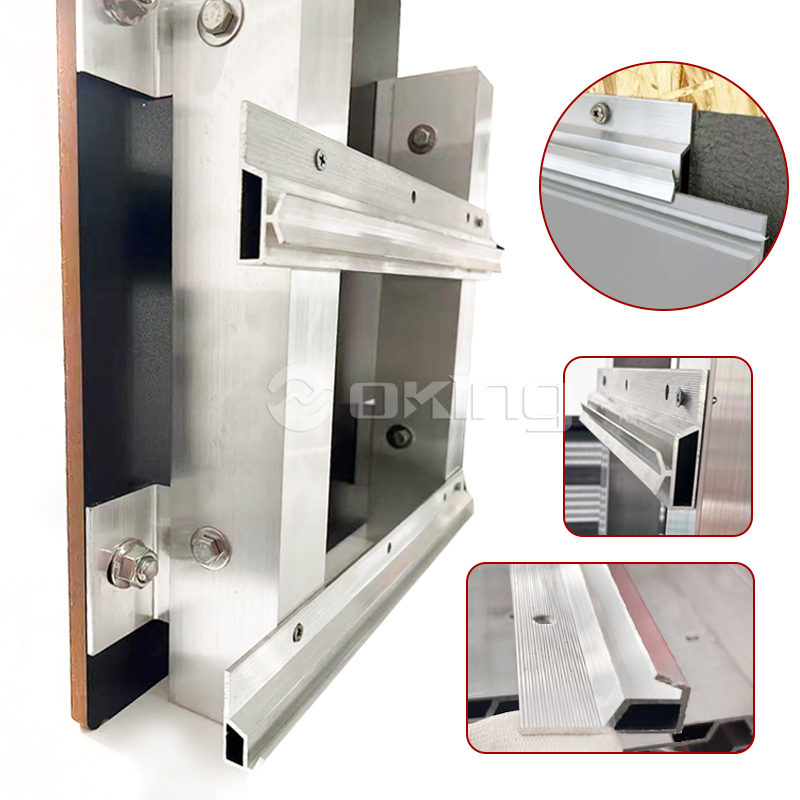
Aluminium and stainless steel sit roughly 0.4 to 0.6 volts apart in the galvanic series in seawater, and in a wet joint the aluminium becomes the anode. Area ratio decides the damage: a large stainless cathode facing a small aluminium anode drives rapid local loss, which is why an M8 stainless bolt bearing directly on an aluminium bracket is a detail worth redesigning.
Three controls work. EPDM or nylon isolating washers under stainless fasteners bearing on aluminium, a barrier coating or anodised layer at the interface, and drainage that stops the joint holding water.
Aluminium expands at 23.1 micrometres per metre per kelvin, 1.4404 stainless steel at 16.0 and carbon steel at 12.0. A 3 metre aluminium cladding rail on a facade facing a 40 kelvin surface temperature swing therefore moves about 2.8 millimetres relative to the structure. Slotted holes and sliding clips absorb that movement; a fully bolted, rigid connection does not, and the load migrates into the panel or the substrate.
For a 50-year design life, 1.4404 stainless steel is the minimum grade for ISO 9223 C4 and C5-M atmospheres, while hot-dip galvanized carbon steel to EN ISO 1461 covers C3 and inland C4.
| Material and finish | Key specification | ISO 9223 category | Typical use |
| Carbon steel, electroplated zinc | ISO 2081, 5 to 12 micrometres of zinc | C1 to C2 | Dry interior fixings and concealed framing |
| Carbon steel, hot-dip galvanized | EN ISO 1461, 85 micrometres average at 6 millimetres and above | C3 and inland C4 | Cast-in anchor channels, strut and brackets away from the coast |
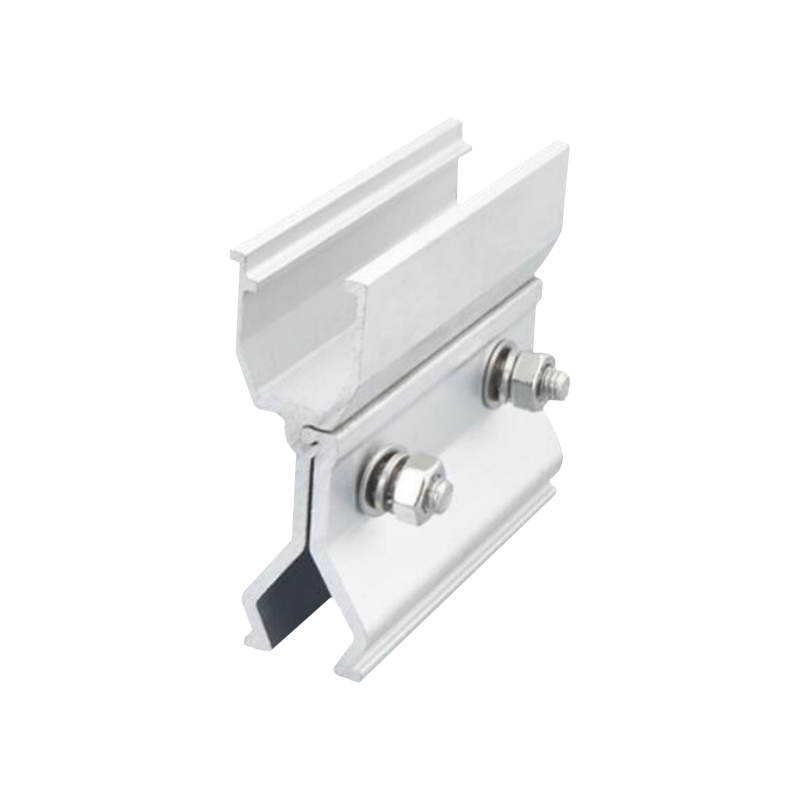
| Aluminium 6063-T6 | EN 755-2 extrusion, mill or anodised finish | C1 to C3 with isolation | Cladding brackets, photovoltaic rails, panel support |
| Stainless steel 1.4301 (AISI 304) | EN 10088, PREN about 19 | C3 and inland C4 | Interior and inland cladding fixings |
| Stainless steel 1.4404 (AISI 316L) | EN 10088, PREN about 25 | C4 and C5-M | Coastal facades within 10 kilometres, de-icing salt zones |
| Duplex 1.4462 (2205) | EN 10088, PREN about 35, proof strength 450 megapascals | C5-M and CX | Splash zone, offshore and high-load coastal fixings |
Category CX, which covers tunnels treated with de-icing salts and offshore splash zones, pushes the specification to 1.4529 stainless steel at a PREN of about 44, or to duplex 1.4462 where the loads justify the lower alloy.
The same facade system 15 kilometres inland and 300 metres from the sea requires different fixing grades, coating systems and inspection intervals, even when wind load and panel weight are identical.
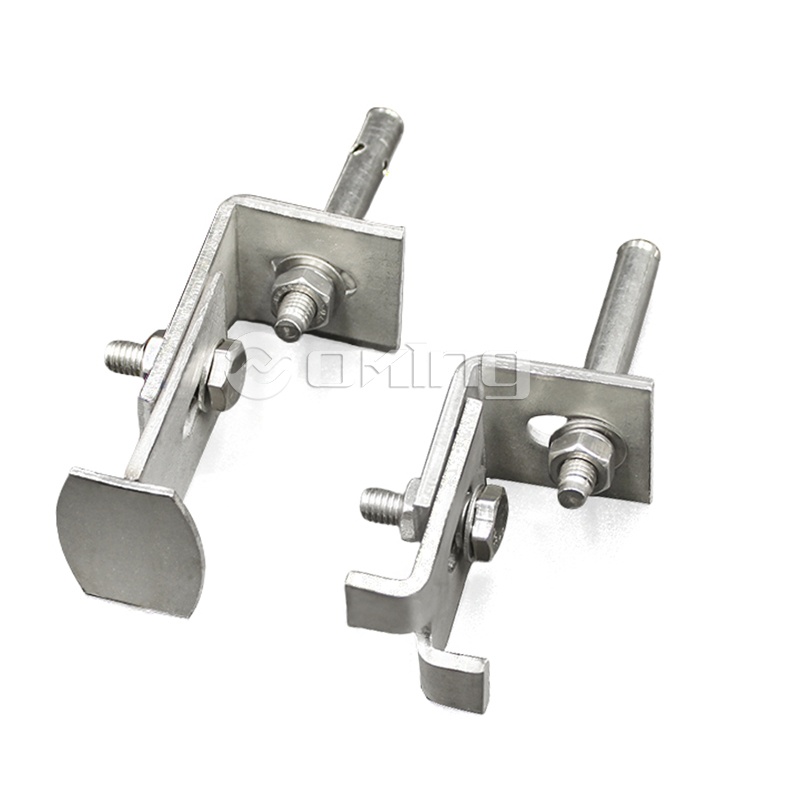
What does not change between the two columns is mechanical capacity. The brackets carry the same loads in both; only the corrosion allowance and the isolation detail move. Adjustable stainless steel L-angle brackets in 1.4404 are the standard answer on the coastal side, because the slotted leg absorbs tolerance and thermal movement without introducing a rigid couple.
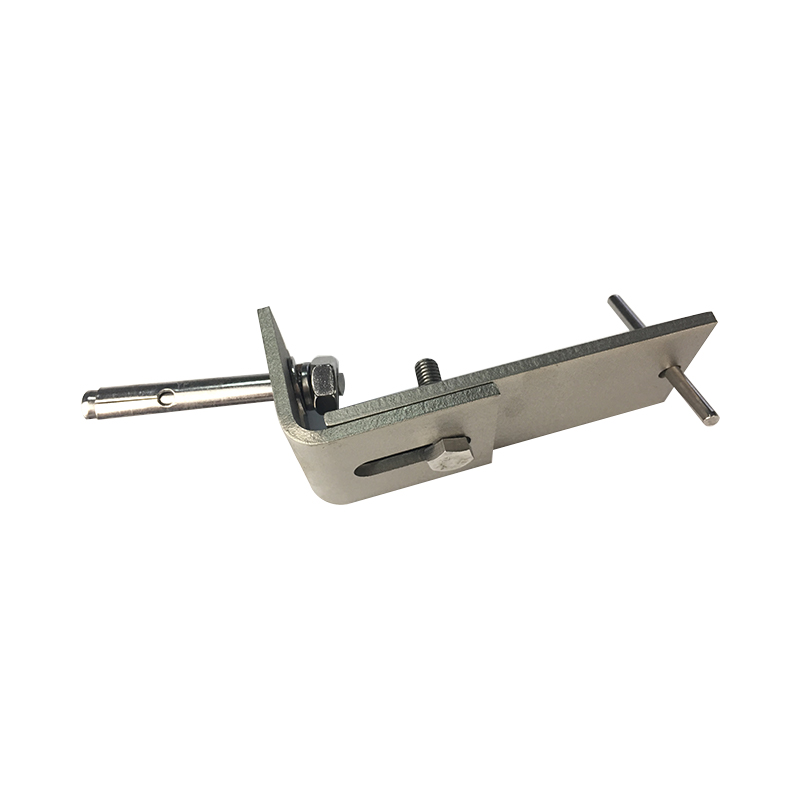 Stainless Steel Adjustable L-Angle Cladding BracketReview 1.4404 bracket adjustment ranges, load ratings, and isolation details for ventilated facades where coastal corrosion and tolerances drive the specification.View Product →
Six checks, run in order, settle the material specification before a purchase order is raised.
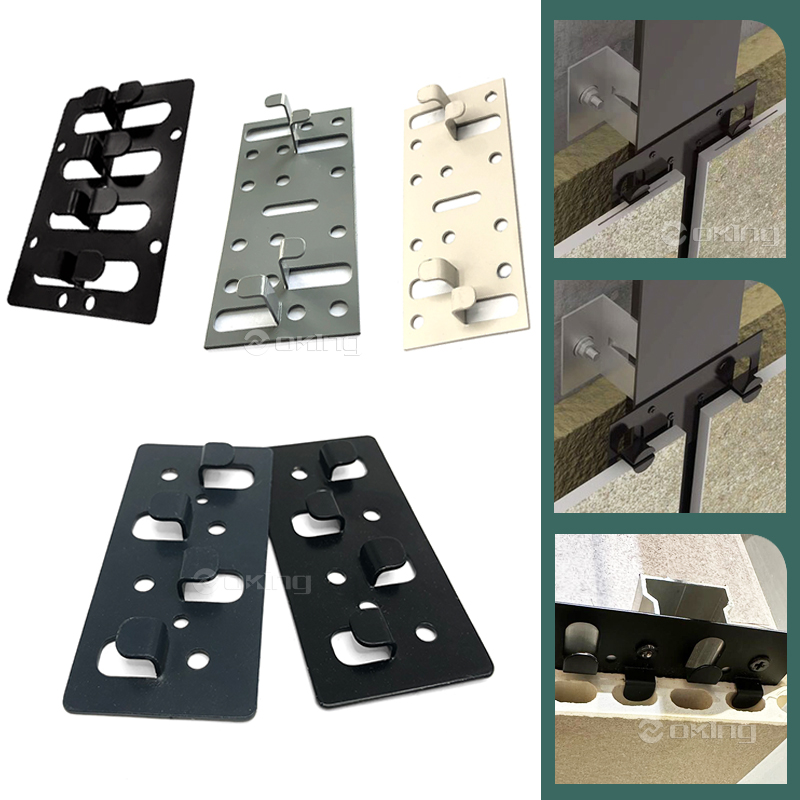
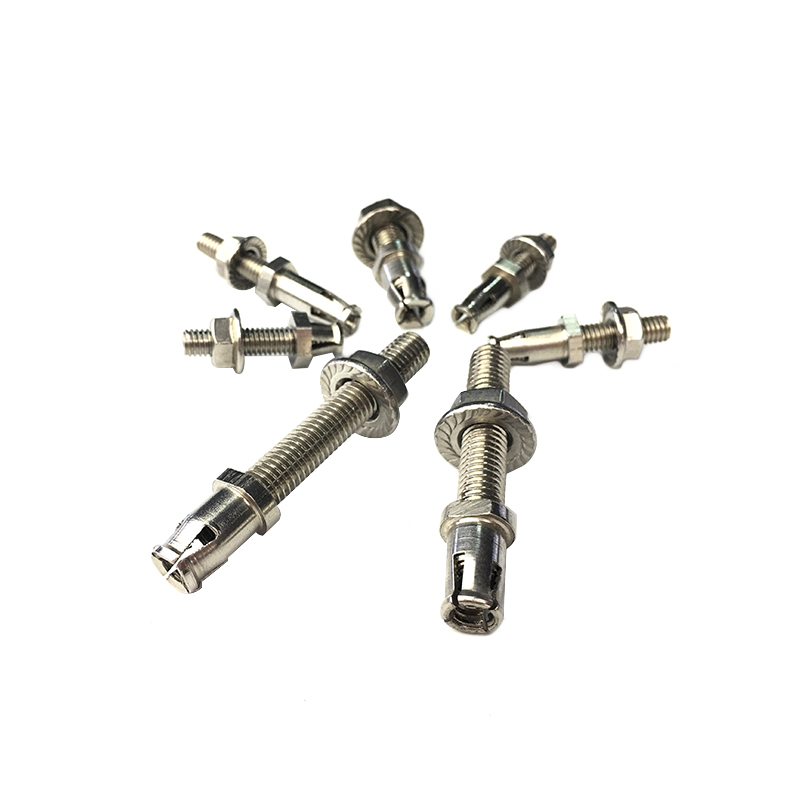
Stone cladding adds one more material decision: drop-in undercut anchors in 1.4404 distribute load through a mechanically keyed cone rather than a friction grip, so the stone slab and the stainless fixing are matched on both strength and chloride resistance.
 Dorp In Undercut Anchor for Stone CladdingSee how 1.4404 undercut anchors use matched cone geometry to fix natural stone panels, with M6 and M8 sizes and load figures.View Product →
Jiangsu Aozheng Metal Products Co., Ltd. holds these grades across cast-in anchor channels, cladding brackets, undercut anchors and strut channels, in 1.4301, 1.4404 and 1.4462 stainless steel and in hot-dip galvanized carbon steel, which lets one material specification run from the embedded channel through to the final panel bracket.
EN 1990 places a 50-year working life in design class 4, and fixing hardware inside that class is designed as a non-replaceable element rather than a consumable one.
The cost case follows from access rather than material price. A bracket 40 metres up a ventilated facade is reached with the same mast climber or rope access team that replaces a panel, so a corrosion failure at year 12 costs far more than the material delta between 1.4301 and 1.4404, which is concentrated in the molybdenum content of a few hundred kilograms of stainless steel. Durability is bought once, at specification stage, and paid for either then or at height later.
No for C5-M positions. 1.4301 carries a PREN of about 19 because it has no deliberate molybdenum content, so specify 1.4404 at PREN 25 as the minimum within 10 kilometres of the shoreline and 1.4462 duplex at PREN 35 in the splash zone.
EN ISO 1461 requires an average of 85 micrometres with a 70 micrometre local minimum on steel 6 millimetres and thicker, 70 and 55 micrometres between 3 and 6 millimetres, and 55 and 45 micrometres between 1.5 and 3 millimetres. Specify coating mass as well, since 85 micrometres corresponds to about 610 grams per square metre.
Yes, with isolation. The two metals sit about 0.4 to 0.6 volts apart in the galvanic series, and where a large stainless cathode faces a small aluminium anode the aluminium corrodes quickly. An EPDM or nylon washer between the fastener head and the aluminium removes the direct couple.
Yes. Steel and stainless steel fixings are classified A1 to EN 13501-1, while aluminium 6063-T6 loses more than half of its room temperature proof strength above roughly 200 degrees Celsius. Fire-rated facade systems therefore specify steel or stainless brackets even where aluminium would win on weight.

We will wholeheartedly provide you with high quality products, reasonable price, on-time delivery and attentive service.
Maoshan Taiwan Business Industrial Park, Dinan Town, Xinghua City, Jiangsu Province, China

+86-523-82799922

+86-15996094444

+86-523-82799933


Copyright © Jiangsu Aozheng Metal Products Co., Ltd. All Rights Reserved.
 English
 русский
 Español
 عربى



Contact Us